Bedding · Pillowcase design
Oxford or Housewife? Understanding Gingerlily Pillowcase Designs
A pillowcase is a small detail with an outsized effect on a bed’s appearance and everyday routine. Oxford and housewife styles share the same basic purpose, but their silhouettes differ: one frames the pillow with a border; the other keeps a clean, close outline. Knowing what that distinction means—and what it does not—makes choosing easier.
Published November 4, 2026
The difference, in brief
An Oxford pillowcase has a fabric border around the central pillow area. The border, sometimes called a flange, extends beyond the pillow’s edges and creates a framed appearance when the case is laid on the bed. A housewife pillowcase has a simpler shape: fabric finishes near the edge of the pillow, without that decorative border.
These names describe a style, not a material. Either design may be made from silk, cotton, linen, or another fabric, and either may use an envelope closure. They also do not tell you whether the case will suit your particular pillow. Dimensions, depth, and closure details still matter.
For Gingerlily pillowcases, the product description is the best guide to the actual construction. Some Oxford designs specify a border width—for example, the Ebury Oxford Silk Pillowcase has a 7 cm border and an envelope closure. A simpler design, such as the Ebury Housewife Silk Pillowcase, is described with an envelope closure and no Oxford border. Comparing those details is more useful than relying on the style name alone.
What an Oxford border contributes
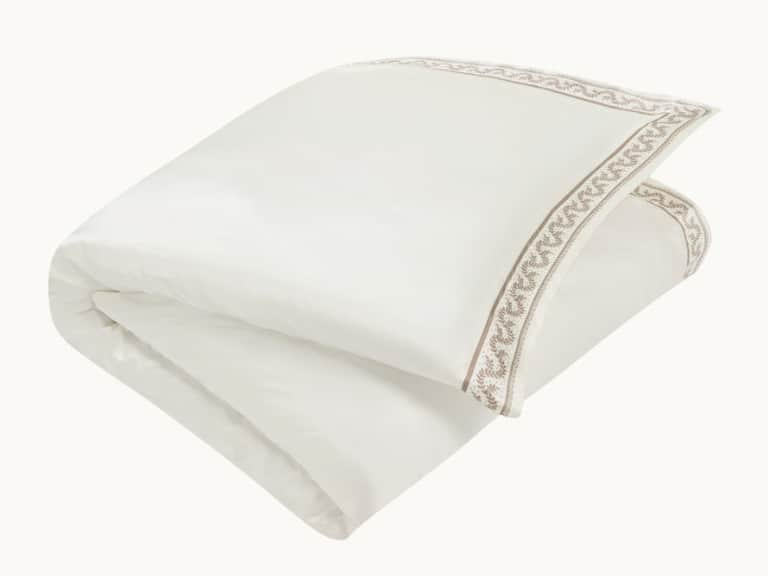
The Oxford border changes the outline of a pillowcase. Rather than ending at the pillow’s edge, the fabric continues outward to form a visible frame. The result can feel more finished or decorative, especially when the pillow sits at the head of a carefully made bed. A border may be plain, contrast with the main fabric, or carry a printed or embroidered detail, depending on the design.
That frame also changes how the pillowcase occupies space. On a neatly arranged bed, the extended edge can help distinguish the pillow from the layers around it. When several pillows are stacked, the border may be visible around the front pillow or along the sides. The effect is not inherently formal or casual; color, fabric, proportion, and the rest of the bedding all influence the impression.
Border dimensions are worth checking. A 7 cm border, for instance, will have a different visual presence from a narrow edge. The stated measurement usually refers to the border detail, not to the size of the pillow that fits inside. Check the case dimensions separately, particularly if your pillows are unusually deep or use a less common size.
Because an Oxford case includes extra fabric at the edge, its border can shift, fold, or become caught beneath another layer during use. That is a styling consideration, not necessarily a drawback. If you like a pillow to have a defined frame, a little adjustment when making the bed may be worthwhile. If you prefer a streamlined appearance with fewer projecting edges, the housewife style may be more appealing.
Why housewife designs remain a classic
The housewife pillowcase is the quieter of the two profiles. Its outline follows the pillow more closely, leaving the surface and fabric to do most of the visual work. That simplicity makes it easy to combine with different sheet and duvet-cover designs, and it can suit a bed where the goal is a calm, unfussy finish.
“Simple” does not mean unfinished. A housewife case can still have carefully made seams, a neat edge, a secure closure, and a lustrous or patterned fabric. Its defining feature is the absence of the Oxford border, not a lack of detail or quality. In a silk pillowcase, for example, the smooth surface and natural sheen may be the main focus, without an added frame.
Housewife designs can also be a practical choice for people who want a close-fitting outline. With no projecting border to arrange, the case may be quicker to smooth when making the bed. The actual fit still depends on the measurements and construction, though: a housewife style is not automatically tighter or more secure than an Oxford one.
In Gingerlily’s range, the Ebury Housewife Silk Pillowcase is specified as 100% mulberry silk, 19 momme, with an envelope closure. Those details tell you more about the case’s material and fastening than the word “housewife” does on its own. They are useful points of comparison when choosing among silk pillowcases.
The closure: a separate choice
It is easy to confuse the border style with the way a pillowcase closes. They are separate features. Oxford and housewife cases can both use an envelope closure, in which an overlapping section of fabric helps hold the pillow inside. Other cases may use a different fastening, so the product description should be checked rather than assuming every design is identical.
An envelope closure keeps a visible fastening off the sleeping surface and offers a simple, low-profile finish. When inserting the pillow, tuck it fully into the case and arrange the overlapping fabric as directed by the construction. If the pillow is overfilled for the case, the closure may not sit neatly; if the case is too large, excess fabric can bunch. Matching pillow and case dimensions is therefore as important as choosing between Oxford and housewife.
Look for wording such as “envelope closure,” “knife edge,” or “Oxford border” in the product details. A knife edge describes a clean, narrow finish rather than an extended Oxford frame. These terms can appear together: a case might have an Oxford border around its body while using an envelope closure to secure the pillow. Read the construction notes as a whole, not as a single label.
Silk, weight, and the feel of the case
Choosing the outline is only part of the decision. Fabric affects the way a pillowcase feels, falls, and responds to care. Mulberry silk is a natural protein fiber with a smooth surface and a characteristic sheen. In bedding, it is often selected for its soft hand and the way it drapes. The precise feel depends on the fabric’s weave, finishing, weight, and construction, so “silk” alone does not describe every aspect of the experience.
Silk bedding may be labeled in momme, a measure used to describe silk fabric weight. A higher number generally indicates more silk by area, but momme should be considered alongside the weave and the maker’s construction details. It is not a direct substitute for reading the product specification or care label. Two cases with a similar listed weight can still differ in finish, border, and hand.
For example, the Gingerlily Ebury Oxford and Ebury Housewife pillowcases are both described as 100% mulberry silk at 19 momme. The Oxford version adds a 7 cm border; the housewife version has a simpler profile. That comparison makes the distinction clear: the style changes the outline, while the listed fiber and weight identify other aspects of the material.
Claims about what silk can do for skin, hair, or sleep should be treated thoughtfully. A smooth surface may feel comfortable and can create less friction than some rougher textiles, but a pillowcase is not a medical treatment and cannot guarantee a particular result. Choose it for the material, feel, and practical qualities you value, not as a promise of health benefits.
How to choose the right silhouette
Start with the bedroom rather than with an abstract rule about which style is better. An Oxford pillowcase may suit a bed where pillows are part of the visible arrangement and an extra border would add definition. A housewife case may suit a simpler scheme, a compact-looking bed, or someone who prefers a clean edge. Neither style is inherently more comfortable; comfort depends more on the pillow, fabric, fit, and personal preference.
- Consider the look you want. Choose Oxford for a framed edge; choose housewife for a closer, unbordered outline.
- Check the measurements. Match the case to the pillow’s length and width, and consider its depth or loft.
- Read the closure details. An envelope fastening may appear on either style, but specifications can vary.
- Compare fabric information. Check fiber content, momme where listed, weave or finish, and any contrasting panels.
- Think about the rest of the bed. A border can coordinate with a duvet-cover edge or stand out against plain sheets; a housewife case can let a print or color carry the look.
- Consider laundry habits. Choose a case whose care requirements fit the time and methods you can reliably provide.
There is no need for every pillow on a bed to make the same visual statement. A coordinated set can look composed, while a deliberate mix—such as a bordered case paired with a plain one—can add variation. If combining styles, repeat a color or material elsewhere in the bedding so the arrangement feels considered rather than accidental.
Care: follow the label, not the style name
Oxford and housewife describe design, not washing instructions. Care depends on the fiber, finish, color, and product construction. Silk pillowcases often require more attentive handling than everyday cotton cases, but instructions can differ between products. The label supplied with the item should take precedence over general advice.
Some Gingerlily silk pillowcase descriptions specify a delicate machine cycle at no more than 30°C, a mild liquid detergent, air drying, and a cool iron if needed. Other silk products may have different instructions. Check the care details for the exact item before washing; do not assume that every silk case is washable in the same way. Avoid treating a dry-clean-only textile as machine washable simply because another silk item can be washed at home.
When machine washing is allowed, a gentle cycle and a mild detergent intended for delicate fabrics can help limit unnecessary stress. Washing similar colors together reduces the risk of color transfer, and turning the case inside out may be recommended for some designs. Avoid bleach and high heat unless the care label explicitly permits them. Air drying is often listed for silk bedding; use a clean, well-ventilated place and keep the fabric away from intense heat.
Ironing, if allowed, should follow the stated temperature guidance. A cool setting is often recommended for silk, and ironing while the fabric is slightly damp may make smoothing easier, but the label remains the authority. Pressing a decorative border aggressively can distort its shape; use light handling and avoid pulling at seams or closures.
Routine care matters as much as the occasional wash. Remove the pillowcase gently rather than tugging hard at the closure, and store clean silk bedding somewhere dry. If a snag appears, do not pull the loose thread. Addressing small problems carefully can help preserve a delicate textile’s appearance over time.
A closer look at common misconceptions
Oxford does not mean a different fiber. The term refers to the bordered style, not to a particular kind of silk or a promise about softness. The material must be stated separately.
Housewife does not mean lower quality. It is a profile with a simple edge. Quality depends on the fiber, workmanship, finishing, and how well the case suits its intended use.
A border does not guarantee a better fit. The border is an extended decorative edge. Pillow dimensions and the inner case measurements determine whether the pillow fits comfortably.
Envelope closures are not exclusive to one design. They can be used on both Oxford and housewife cases. Check the specific product description.
More elaborate does not always mean more practical. A decorative border may be exactly the finishing touch someone wants, while another person may prefer the ease of a minimal outline. The better choice is the one that works with the bed and the household routine.
A simple buying checklist
Before choosing a Gingerlily pillowcase, confirm the pillow size and compare it with the listed case dimensions. Decide whether you want a border and, if so, note its width. Then check the fiber content, silk weight if provided, closure, and care instructions. These details answer different questions: style, fit, material, security, and maintenance.
If you are building a coordinated bed, compare the pillowcase’s color and finish with the sheets and duvet cover. A matching set can make the bed feel unified; a contrasting border can provide a subtle accent. A product such as the Ebury Oxford Silk Pillowcase makes the frame part of the design, while the Ebury Housewife Silk Pillowcase keeps the edge understated. The choice is ultimately about the visual line you want around the pillow.
Finally, consider how often you plan to wash the case and whether its care requirements fit your routine. A material that feels appealing in store still needs to work at home. Clear product information is especially valuable for delicate bedding, where a little attention to washing and drying can help protect the fabric and finish.
The final distinction
Oxford and housewife pillowcases do the same basic job, but they frame it differently. Oxford adds a border that makes the pillow’s outline more pronounced. Housewife keeps the edge simple and close. Neither determines the fabric, fit, closure, or care instructions; those details must be checked independently.
For a considered choice, begin with the pillow’s measurements, then weigh the visual effect of the border against your preferred level of simplicity. After that, compare the material and care label. A pillowcase is a modest piece of bedding, but its finish is visible every night and its care repeats with every wash. The right design is the one that looks at home on the bed—and remains practical once it is there.